Ledger: Cash Journal |
Top Previous Next |
Hover the mouse over the different menu options. If the cursor changes to a hand ( ), then click to go to the subject.


Cash Journal
Go to: Ledger > Cash Journal
The Cash Journal is used to record cash deposits and cash withdrawals. It helps you track your business's cash movements and maintain accurate cash flow records.
Tip: Use the Cash Journal only for general cash transactions. Supplier payments and customer receipts should be recorded in their respective journals..
When not to use the Cash Journal
Use these dedicated modules instead:
Transaction |
Use |
Pay a supplier |
|
Receive a customer payment |
Open the Cash Journal from the Ledger module.
You can:
•Create a New Withdrawal (Payment)
•Create a New Deposit
•Look up existing journals
•Reverse journals (when permitted)
•Import or export journals

Looking Up Existing Journals
Use the lookup options to find previously captured journals.
Show Type
Choose whether to display:
•Payments (Withdrawals)
•Deposits
Show Completion
Enable this option to include completed journals in the lookup.
Reversing a Journal
If a journal was captured incorrectly, you can reverse (delete) it.
A journal cannot be reversed if:
•Bank Reconciliation has already been completed.
•Tax has already been processed.
For additional correction methods, see Corrections.
Creating a New Cash Journal
Select one of the following:
•New Withdrawal
•New Deposit
The corresponding entry screen opens.
Hover the mouse over the different fields on the form. If the cursor changes to a hand () , click to get more information.
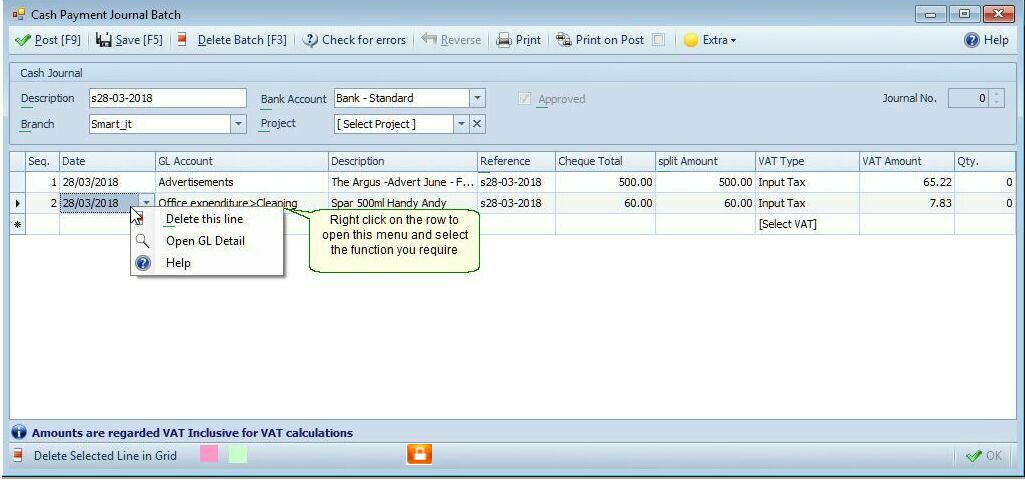
Cash Journals
Note: Cash register payments•If a payment is made directly from the cash register, select your Cash Control General Ledger account. This ensures the transaction is included in your Cash Up. •Expenses paid directly from the till should be recorded in the Cash Up module rather than in the Cash Journal.
|
Cash Journal Fields |
|
Reference |
Reference field in the Cash Journal and Adjustment Journal formUse the Reference field to record the source document, such as an invoice number, receipt number, or other supporting document. If necessary, you can edit the reference later by: 1.Opening the GL Detail form. 2.Right-clicking the transaction. 3.Selecting Correct this entry. |
Split Amount |
Split Amounts in the Cash JournalUse Split Amount when one payment or receipt needs to be allocated across multiple General Ledger accounts.
Example You pay a supplier $4,000 covering:
•Hardware •Stationery
Instead of posting the full amount to a single account, split the transaction between the appropriate General Ledger accounts.
|
Quantity 1 & 2 |
Keeping track of quantities in the Cash JournalThe Quantity 1 field accepts whole numbers (integers), while Quantity 2 accepts decimal values. These optional fields let you record non-financial quantities alongside a Cash Journal transaction for reporting and analysis.
Use them to track operational information such as consumption, distance travelled, production quantities or other measurements.
Examples •When paying a municipal account, record the liters of water used in Quantity 1. •When recording a fuel purchase, enter the kilometers traveled in Quantity 1 and the liters of fuel purchased in Quantity 2. Reporting on QuantitiesTo view and analyze recorded quantities: 1. Open General Ledger > GL Enquiry. 2. Use the GL Enquiry Summary Bar to display: •Sum •Average •Minimum •Maximum •Count
Tip: Quantity fields are optional and do not affect the financial value of the transaction. They are useful for tracking operational information such as usage, consumption, distance, or production quantities.
|
Importing or Exporting a Cash Journal
To import or export Cash Journal transactions:
1. Open the Cash Journal.
2. Click the Extra Menu button.
3. Select Import or Export.
Cash Journal Approval Process
You can require approval before Cash Journals are posted.
The approval workflow ensures that journal capture, approval and posting can be performed by different users.
Role |
Responsibilities |
Clerk |
Captures the journal but cannot approve or post it. |
Manager |
Reviews and approves the journal but cannot post it. |
Auditor |
Posts the approved journal. Cannot change the approval status. |
Each stage is controlled through Security Settings, ensuring users can only perform their assigned tasks.
Alternative Workflow
If a three-stage approval process is not required, the Manager can be given permission to both approve and post journals while the Clerk captures the entries.
Approval Process
To require approval before posting:
1.Go to Ledger > Account Options.
2.Select the Restrictions & Options tab.
3.Select Do cash journals need approval.
If this option is not selected, the Approval and Process controls are hidden.
Configure Cash Journal Security
Before configuring security, ensure the Cash Journal is open.
Assign permissions for each security group:
Role |
Permissions |
Clerk |
Not allowed to approve or process.. |
Manager |
Only allowed to process. |
Auditor |
Allowed to process but cannot change approval status or edit. |
Tip: Security permissions can be customized to match your company's approval process.
Bank Account
Only General Ledger accounts marked as Reconcilable in General Ledger > Account Setup are available for selection.
Tip: If you frequently make payments from Petty Cash, mark the Petty Cash account as Reconcilable. This allows the account to appear in the Cash Journal and can eliminate the need to create adjustment journals for petty cash transactions.
Print on Post
Select Print on Post to automatically print the Cash Journal batch after it has been posted.
