Customer Journals |
Top Previous Next |
Hover the mouse over the different menu options. If the cursor changes to a hand ( ), then click to go to the subject.



Customer Journals
Go to: Customer > Customer Journals
The Customer Journals module is divided into two sections:
•New Payment Received
•New Journal

Customer Journals > New Payment Received
This section is used to record payments received from customers directly into a bank account.
 Important:
The preferred method for recording customer payments is: Customer > Receive Payment.
Use Customer Journals only for payments when you need special features such as consolidating multiple payments into one bank entry.
When to use New Payment Received in Customer Journals:
•You receive one combined bank payment that covers multiple customers or invoices (common with government or group accounts).
•You want a single bank entry in the General Ledger
•You need to allocate one payment across multiple customers or invoices
•You can print separate statements for each agency/customer (not possible with the Paid By option).
Example Use Case:
Different government agencies purchase from you, but you receive one lump-sum payment from the Provincial Treasury.
Each agency has its own invoice, but you want only one single bank entry of the total amount in your GL.
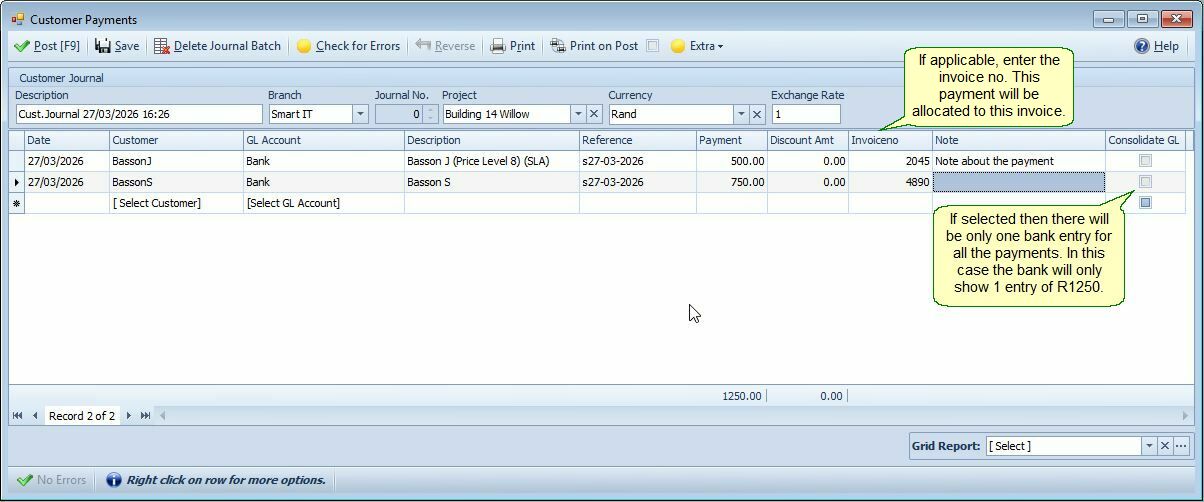
By using Consolidate GL, the system creates one bank debit entry while still correctly allocating the payment to each customer’s invoice.
How Consolidate GL Works
•Allows Consolidate GL (one bank entry for multiple customer allocations)
•Each customer’s balance is updated individually
•Individual customer statements remain available
(unlike the Paid By option)
New Journal
Use the New Journal section to:
•Capture opening balances when setting up customers
•Process manual adjustments (debit or credit notes not linked to normal invoices)
•Correct customer account errors
Image of a Customer Journal.

Important Fields on the Customer Journal Form (See screenshot above for visual reference)
|
|
Post |
Transfers journal entries to the general ledger. |
Save |
Saves the batch without posting. |
Delete Journal Batch |
Deletes the current journal batch.
|
Check for Errors |
Validates entries before posting.
|
Reverse |
Reopens a posted batch for correction or deletion
|
Import |
Imports journal entries via Excel.
|
Prints the journal.
|
|
Print On Post |
Automatically prints the journal upon posting.
|
Discount Amount Column |
Function: A credit (Cr.) amount in the discount column reduces the customer’s balance. Example: If the credit amount is $800 and the discount is $200, the customer’s balance is reduced by $1,000.
|

How to Process a Refund
Example: A customer paid a deposit and needs to be refunded.
Refunds can be processed via EFT, petty cash, or other methods.
Steps to Refund a Customer:
1.Select the Customer from the list.
2.Choose the Account for the refund (e.g., Bank, Petty Cash, or Safe).
3.Enter the refund amount in the Debit column.
4.Post the transaction.
See also
•Corrections: Refer to the Corrections guide for handling errors.
•Customer Receipts: See the Customer Receipts guide for detailed payment processing.
